
This is going to be a little bit of a different post than you usually see here. Tomorrow I celebrate seven years of sobriety. There are spiritual reasons I gave up drinking alcohol, so I thought it was important to share this milestone here. If you have no interest in sobriety, feel free to stop reading and come back next week where I’ll be back to ranting about theology. But if you’re sober-curious, please feel free to keep reading.
When I tell people I’ve gone completely sober, they usually ask me two questions.
Were you sick? No. At least not that I know of. That’s not what inspired me to stop drinking all together.
Are you an alcoholic? No. At the risk of offending some people, I don’t believe there is any such thing as an alcoholic. If we’re being honest, most people who start drinking don’t stop, they continue drinking in some fashion the rest of their lives. Yet we often think that people who stop drinking are the ones with the problem. That’s nuts to me. Now, I’ve had people very close to me with serious substance abuse issues of all kinds. I’m not saying you shouldn’t get help if that’s where you’re at. That just isn’t my story. I felt comfortable saying alcohol is not right for me and never once thought I was an alcoholic or had any issues other than physical dependency.
We don’t call cocaine users “cocaine-aholics.” We would never say, “that guy can really handle his heroin.” We would never tell ourselves, “I only take meth after 5PM, and then it’s only once or twice each night.” Alcohol is an addictive drug and if you keep taking it you will get addicted just like any drug. If calling yourself an alcoholic keeps you from drinking, please just keep naming it. But overall, I think that the stigma the word brings keeps people in a gray zone in their lives. You don’t need to hit some sort of bottom to realize alcohol is a dangerous drug.
Around seven years ago, I didn’t even think of it as a drug.
Then one day, after 20 years as a top marketing executive, I realized alcohol was my number one occupational hazard. I didn’t have to worry about cutting off a hand, falling into a ditch or getting hit by a forklift. I had to worry about being around a bunch of software entrepreneurs getting together to drink poison with each other. You know, for fun.
A good friend of mine courageously shared her journey to sobriety with words like, “I got my brain back,” and, “I have total control of my life,” and it got me thinking, “wait, I only drink wine and martinis, am I on drugs and didn’t even realize it?”
Once I recognized that alcohol is not just another drug, but what the British Medical Association calls the most dangerous drug on the planet, I had to ask myself:
- Why am I drinking a brain-damaging neurotoxin that causes permanent brain injury and dramatically increases the chance of developing Alzheimer’s, ALS, MS, brain tumors and more?
- What is it giving me that I cannot give myself? What void am I trying to fill and wouldn’t I rather just deal with that?
- Why would I ever want to be numb around my family and friends? What situation can possibly be improved by being intoxicated?
- Why can’t I just be myself when I actually like myself a lot?
- How is life possibly better taking a poisonous drug that causes cancer?
- How much am I spending on alcohol in a year? Including losing 15 minutes of my life for every beer. The risk level of one beer is about the same as one cigarette. How many cigarettes do I support smoking for my health?
But, I wasn’t drinking that much was I? Everyone drinks like this. Turns out that was a big no. Look at this chart:
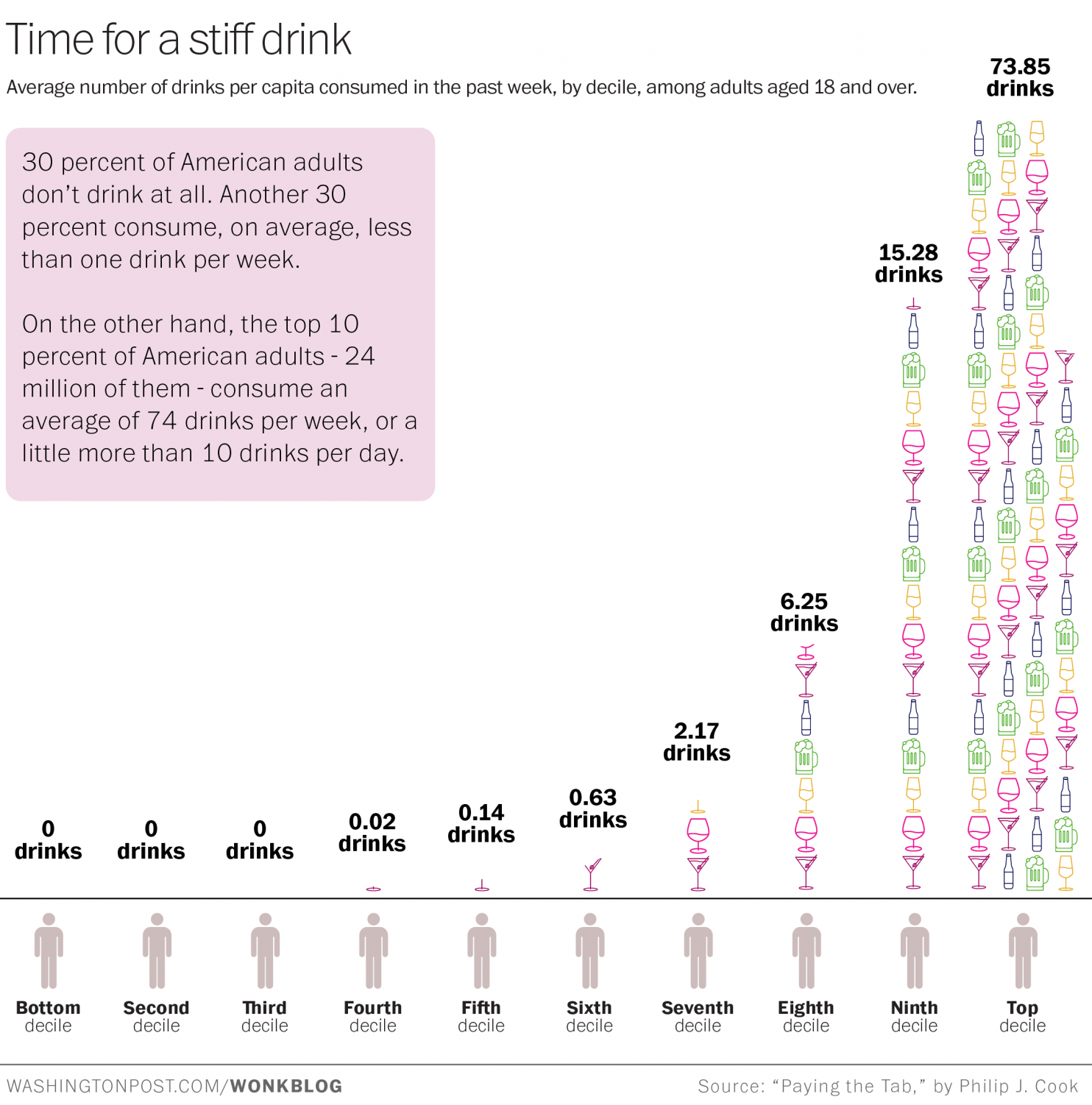

- 30% of Americans don’t drink at all. And this chart is a little old. I’ve heard that GenZ grew up with hard-drinking GenX parents and learned that alcohol is not so great after all. In their 35th anniversary issue, Men’s Health Magazine reported that 42% of its readers don’t drink at all. But I like this chart and wanted to stick to a conservative estimate, so let’s go with 30%.
- The next 20% drink less than 7 drinks all year long, maybe holidays or a night out.
- If you have two drinks a night, you are in the ninth decile of all drinkers in America.
- If you’re in the top 10%, well, my folx…
- Also notice the shape of the curve. Alcohol is great at one thing: making you want to drink more alcohol.
But in the end, as I imagine is the case with most addictive drugs, all these questions and studies weren’t enough for me to quit.
I can be a bit dense, hard-headed even. It took an entire set of other realizations to put me on this path. But I’m so glad I did it. Other than my marriage and my kids, going sober is the most important, radical and life-affirming decision I ever made.

There’s an economy of energy that you have in your life. You just have to devote it to things that are good for you, for the most part, that’s more constructive than drinking. And one of them doesn’t end in uncontrollable vomiting and crying…The first thing I noticed about sobriety? I lost about 20 pounds within a couple of months. I started getting compliments. This was highly motivating. Years later, and through much therapy, I would come to discover all of the really bad things (as opposed to weight gain) alcoholism caused, like anxiety, paranoia, and perpetual emotional infancy.
Chris Hardwick
What were those realizations?
- I watched a lot of my friends and colleagues, people I still admire and respect, completely dissipate in alcohol. You’d be surprised how many C-level executives are fighting this battle.
- I went deep into contemplative prayer. Like many of my friends who do Christian prayer, Buddhist meditation, Sufi prayer and meditation or many other disciplines, I came to realize I am not my brain. I am much more than just a brain. I didn’t want a substance interfering with my deeper contemplative practices. But, my brain is a super-computer I’ve been gifted with. It’s my super power. Why am I drinking kryptonite? My friend was right. Just like her, around day 90 I got my brain back and it was amazing.
- Alcohol is just another form of slavery to consumerism. Our local brewery actually gave out padlocks to its members one year. Their intent was to let you lock up your own private mug in their place. But the symbol was a huge wake up for me. We’ve been sold a great lie by some really big businesses with genius marketing teams. The happiness you get from drinking is really just relieving the anxiety that drinking itself causes. Most people can imagine giving up sugar, pizza or coffee if they had to but not alcohol. Why is that? As they handed out their padlocks to members, I looked around and saw a room full of the walking dead. I knew I was out. No more.
- Andy Murray didn’t drink while he was playing professionally – he may not drink now either, I haven’t looked it up. He didn’t drink because he wanted to be in top form in his career. I don’t really ever imagine a time I don’t want to be in top form. We’re all athletes in training for the biggest events in our lives. Don’t miss out.
- There’s nothing more punk rock than being straight edge. If you want to be a rebel, then don’t dull the blade.
Sobriety, Christian Spirituality and Presence
The Bible is a little bit conflicted in terms of alcohol. Of course, the Bible is conflicted in a lot of ways. If you want to pull some clobber verses out to say that drinking is bad, they are in there. That’s just not what the Bible is for, however. And I don’t believe the typical Baptist apologist rhetoric that somehow Jesus turned water into a kind of new-wine grape juice. It seems to me like he enjoyed wine and even requested it at his last meal. Was wine diluted with water back then as a digestif and anti-microbial? Yes. Was it also quaffed in large quantities at parties? Certainly. We have a lot of myths, proverbs and parables telling us about the dangers of drunkenness to tell us that they knew how to tie one on back then. So, Jesus fully grasped wine as we understand it and apparently encouraged it.
However, I don’t think there is anything especially magical about wine in any sense. Every church I’ve ever attended has at least served grape juice as a communion option, so Protestants are generally open minded about the meaning of wine.
All this to say that there is absolutely no religious precept in Mainline Christianity against drinking like the precepts in many other major religions from Buddhism to Islam to many Protestant denominations. You do you.
What I can talk about here is my own desire to have a deeper connection, a deeper presence in all of life. Just as I don’t want to numb out my experience with friends and family in any sense, I also want complete mindful awareness in my prayer life. For me, I decided that meant total sobriety. One of the interesting things about alcohol is that it can take up to 10 days to completely leave your brain and body. So, if you’re drinking more frequently that every 11 days, you’re probably living in a constant state of withdrawal and anxiety. I didn’t feel like that lent itself to spiritual practice and silent communion with God. I wanted to limit any artificial impediments I needed to deal with in my contemplation. Facing reality is difficult enough without impairment.
Part of entering the Cloud of Unknowing is giving up on the chattering brain and leaving behind its fleeting thoughts, pains, notions, desires and anxieties. Drinking didn’t help that. Drinking sabotaged my brain into a chattering heap. In the end, drinking becomes another attachment to escape. Attachments – at least in my life – come from the desire to fill voids in inner emotional life. I have had a lot of pain and trauma in my own life from early childhood on. Haven’t we all? Becoming sober removed another giant distraction and attachment between me and communion with God while I go deeper trying to understand myself.
Trauma of all kinds create blocks in your spiritual journey. Trauma leads to feelings of shame, guilt and unworthiness. It’s no wonder so many people end up on the wrong side of the chart above. If you don’t think you’re worthy, why not drown that unworthy person in mind-numbing poison? Isn’t that what you deserve? Isn’t it better to die a little every night? Nope, it’s not. It’s better to face the trauma head on.
I didn’t want a coping mechanism in a bottle, I wanted it built into my relationship with God. I didn’t think I could do both. Again, you may be built differently than I am, but I had to strip away attachments to understand the deepest places God wants to reach.
Please understand, not everyone facing trauma becomes attached to alcohol or other drugs. But I have a special place in my heart for people who drink their way into forgetfulness. Other people become attached to much more corrupting things like anger, greed, violence or sex addictions, so attachment to alcohol is relatively benign.
I like the metaphor of a computer virus for alcohol. Alcohol takes over your machine, makes it slower, makes it overheat, prevents you from running your own programs, corrupts your data and more. I want to be clear that trauma, hurt and brokenness don’t go away if you stop drinking. But you can face your issues more easily with a clean, fast computer than with a computer you are constantly running your disk doctor upon. I’m still often depressed, angry, hurt and lonely. But I face that with awareness and understanding of God’s work in my life. I’m present and I’m anchored.
I’ll end it there.
I’m not trying to sell you on anything. I don’t want to preach, but it’s hard not to sound preachy when you’re excited about something.
If you’re sober curious, see if you can make it to 90 days. Peek again at what a healthy brain feels like. Wake up early on a Saturday feeling amazing. Reclaim your life and take control of all aspects of your mental health. Lose 15 pounds. Look 10 years younger.
If you want some help along the way, reach out to me. I’m more than happy to provide any encouragement along the way. Just reach out.
Here are some great resources that helped me.
Thanks for reading my story. Here’s to another seven great years.
Discover more from Humble Walks
Subscribe to get the latest posts sent to your email.
I am a recovering and deconstructing Baptist and alcohol is one area I still agree with my family. But firstly praise the Lord! I’m so proud of you for staying strong and turning away from the temptations of alcohol these past seven years. As you said, alcohol can be a real stumbling block to our spiritual growth and living a life fully devoted to Christ.
I have to respectfully disagree with you though on the Bible’s stance on alcohol. While the Bible does acknowledge that wine can be enjoyed in moderation, I believe the overall message is clear that any intoxication is displeasing to God. The Bible warns repeatedly about the dangers of alcohol and how it can lead us astray.
As Christians, we are called to be sober-minded and self-controlled, not slaves to our fleshly desires. Alcohol, even in small amounts, can dull our spiritual senses and make it harder for us to hear the Holy Spirit’s guidance. That’s why I believe total abstinence is the wisest path, as it removes any temptation or risk.
May God continue to bless and keep you.
Thank you for your kind words and encouragement. I agree with you in spirit but not for biblical reasons. I think there’s a really good reason Buddhism prohibits all intoxicants. Wrong thought leads to wrong action. Alcohol damages your thinking and brain activity long after you feel sober. I didn’t understand this until I quit drinking but my brain changed at 60-90 days so dramatically that I’ll never go back. I don’t think any of us have a 100% perfect spiritual presence in Christ. We’re all broken, we’re all growing. So it’s not like giving up alcohol makes you somehow perfect at prayer or something. But it’s clear to me that it’s one more impediment in your spiritual life. But you know what? So are greed, fear, bigotry, envy, and more. So we all have a lot to work on.
But I don’t think you can get to that conclusion biblically. And this is the main problem with trying to use the Bible as a magic answer book. The Bible has many authors and editors who disagree with each other all over the place. It’s a record of people struggling with God and it’s not going to be consistent. So there are places that seem to me to be really clear that alcohol is bad. Then there are places that celebrate it. So what are we to do but try to be authentic to ourselves in our spiritual development, communion with God, and transformation?
So I would never say that drinking is sinful in a biblical sense. Drunkenness clearly is, but not a little wine here and there. But sin is separaration and I think if you’re honest, that’s the only thing alcohol does. It separates you from everything. There is absolutely no part of experience that is improved with alcohol. Inebriation is itself a gradual deprivation of real experience. Eight years ago I thought it was an experience enhancer. But I couldn’t have seen the truth — about the impact on my awareness, my anxiety, my dopamine receptors and my numbness — until I got to the other side of it. I knew I wanted to give it up deep down, but I didn’t understand the power of sobriety until I was maybe 3-6 months in and had clarity about where I came from and where I now stood.